Could Hawaiʻi Be The First State To Dump Landfills?
Honolulu’s only waste incinerator needs fresh investment to bring it up to international standards, council vice-chair says.
By Matthew Leonard / January 30, 2026
Figuring out what to do with garbage on a small island is a conundrum that has inspired two recent proposals by local and state lawmakers to lessen the addiction to stowing it in a hole in the ground.
One is audacious: Just say no to landfills, a notion sparked during a recent overseas trip. The other is more circumspect, calling for reducing waste while leaning into new technologies.
Both could run headlong into the significant roadblock of a Senate bill reintroduced this legislative session that would add restrictions to repurposing the ash waste created by incinerating trash. Oahu’s municipal generator alone produces 150,000 tons of ash waste every year, which under current laws cannot be disposed of anywhere other than theWaimānalo Gulch Sanitary Landfill in West Oʻahu.
The City and County of Honolulu is discussing acquiring additional land to extend the life of the current municipal landfill, city spokesman Scott Humber said. The facility was due to close in 2028 but remains the only viable option after 11 other sites were rejected. (Kevin Fujii/Civil Beat/2024)
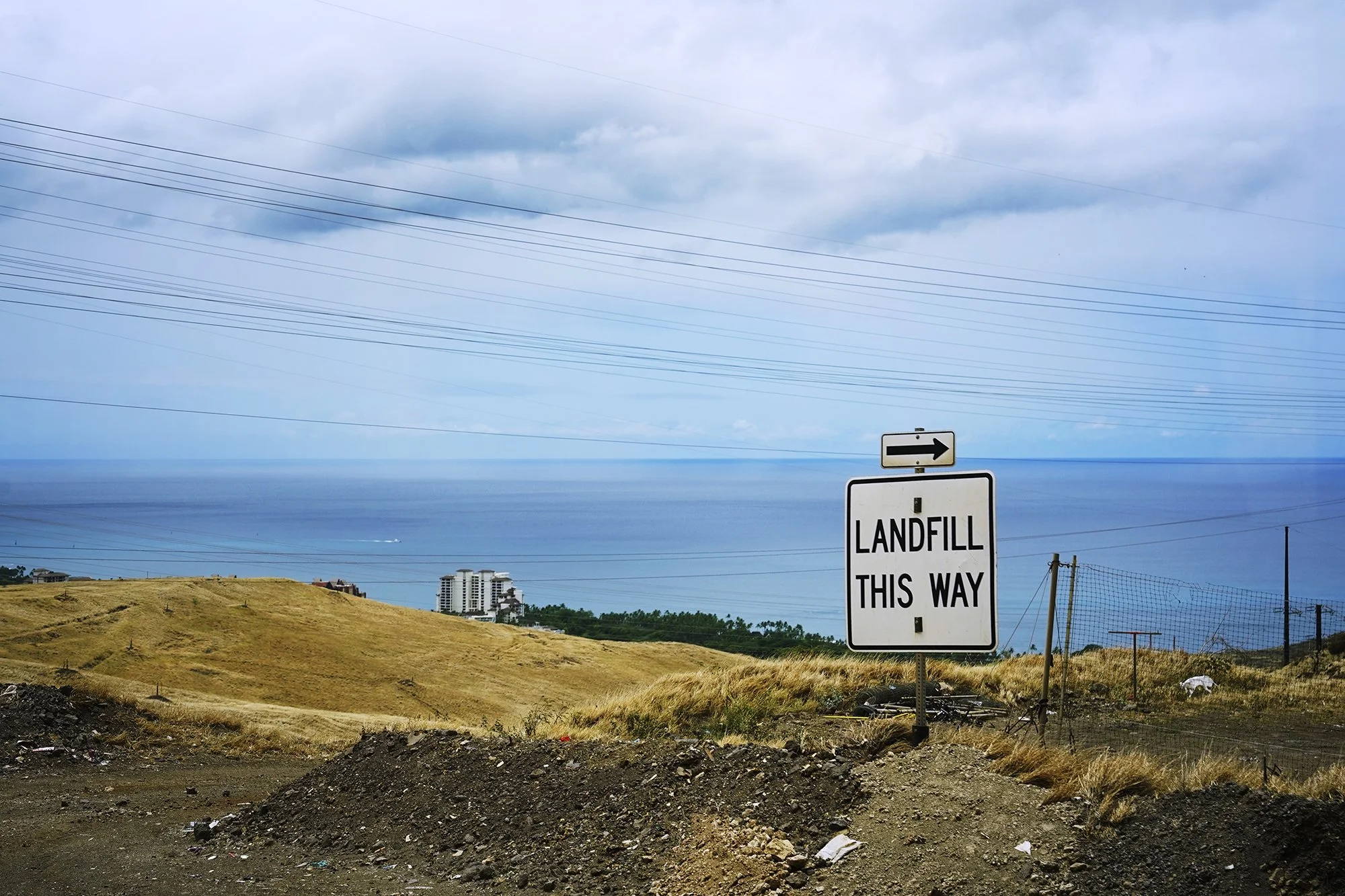
The City and County of Honolulu is discussing acquiring additional land to extend the life of the current municipal landfill, city spokesman Scott Humber said. The facility was due to close in 2028 but remains the only viable option after 11 other sites were rejected. (Kevin Fujii/Civil Beat/2024)
Despite recycling and other reduction efforts, around 1.2 million tons of solid waste were generated on Oʻahu in the 2025 fiscal year, according to the latest data available from the city’s Department of Environmental Services. Every year a quarter of that –– 280,000 tons of construction and development waste and ash from H-Power –– ends up being buried at Waimānalo Gulch.
Waimānalo Gulch was scheduled to close in 2028, but after a fruitless search for an alternative location, the City and County of Honolulu is now discussing extending the working life of the landfill. City spokesman Scott Humber said that 3.7 acres of land is available to extend the landfill’s capacity for the near future, while other options are explored.
“Other than the expansion of Waimānalo Gulch … there is no other place,” Honolulu Mayor Rick Blangiardi told the Senate Ways and Means Committee earlier this week.
Council member Andria Tupola, who represents District 1 where the current landfill is located, is not on board with that approach. Instead of spending money to expand the landfill where it is or relocate it, she says it is time to invest in closing it.
“We are now at a point where so many sites have been excluded that it is impossible for us to re-site the landfill,” she told Civil Beat. “So knowing that it’s impossible, ending it is the only path forward.”
Tupola wants to establish a council working group to investigate closure options, motivated by a recent city funded overseas trip during which she inspected waste disposal technology in China, Denmark and Spain. All three countries are less dependent on landfills, in large part because of more sophisticated incinerators.
Over 2,000 tons of municipal solid waste are processed every day at the H-Power plant run by Reworld Honolulu LLC for the city and county. Reducing the waste deposited in Oʻahu’s landfill will depend on improving the incineration technology since the landfill is the only legal repository for the ash waste from H-Power. (Kevin Fujii/Civil Beat/2024)
Landfill Integral To County Waste Plans
The Westside landfill has been a political hot potato for decades, and “every mayor since 1990 has said they will move the landfill, but they didn’t say they’d end it,” Tupola said.
As she envisions it, the working group would include representatives of the city’s environmental services department and the state health department, as well as the recycling industry, the city’s H-Power waste incinerator, unions and others.
Municipal Waste Streams (MWS) on Oʻahu for 2019-2025, according to the Department of Environmental Services. The two shaded segments at the bottom of each column represent the 25% of solid waste that continues to end up in the Waimānalo Gulch landfill. (Screenshot: Department of Environmental Services.)
The members would consider the available technologies for recycling, diverting and converting solid waste, and “evaluate the feasibility and practical realities of ending landfill dependency,” according to the resolution she introduced in the Honolulu City Council Jan. 12.
A council vote is likely in the next week and the group could be up and running not long after, Tupola said Tuesday. It would report back within a year.
However, meeting any goals it set — including further reducing and repurposing the thousands of tons of waste that end up in the landfill every year — would take far longer.
“Experts I’m talking to say even with a very, very ambitious plan we would still need eight years … and that’s if nothing goes wrong,” Tupola said.
Until then, “landfills remain a necessary component in Hawaiʻi’s solid waste system, particularly for emergency situations and for materials that can’t be reduced, reused or recycled,” according to Roger Babcock, the director of the Department of Environmental Services.
State Group Proposed
Senate Bill 2485, introduced by Sen. Mike Gabbard, would establish a similar working group within the governor’s office to identify policies to further reduce solid waste statewide, not just on Oʻahu.
Both groups would weigh current solid waste regulations, analyze the costs and environmental impacts of alternative technologies for processing waste, and assess what markets are available for new products from repurposed solid waste.
Gabbard said he introduced the bill after learning about Tupola’s council resolution for a municipal working group.
“We’re both from the Westside,” he said, “and it makes sense because we’ll end up with the best results for the community.”