A Last-Minute Miracle For A Bill To Help Hawaiʻi Convert Cesspools
The bill would create a new low-interest loan program to help eliminate some of the 80,000 cesspools leaking millions of gallons of sewage into Hawaiʻi’s nearshore waters daily.
By Marcel Honoré / About 11 hours ago
One of Hawaiʻi’s most prominent clean-water advocates called it an Easter miracle.
A legislative proposal to help homeowners remove the thousands of cesspools that pollute the islands’ coastline by offering them more flexible loan options looked like it had died last month in a Senate hearing.
Then, on Thursday, it unexpectedly saw new life.
A trio of Senate committees took up House Bill 1618 again and approved it, reviving the main proposal in this year’s session to address one of Hawaiʻi’s biggest and most vexing environmental problems.
“That bill,” Honolulu-based Wai Wastewater Alternatives and Innovations Executive Director Stuart Coleman said, “seemed to be resurrected from the dead.”
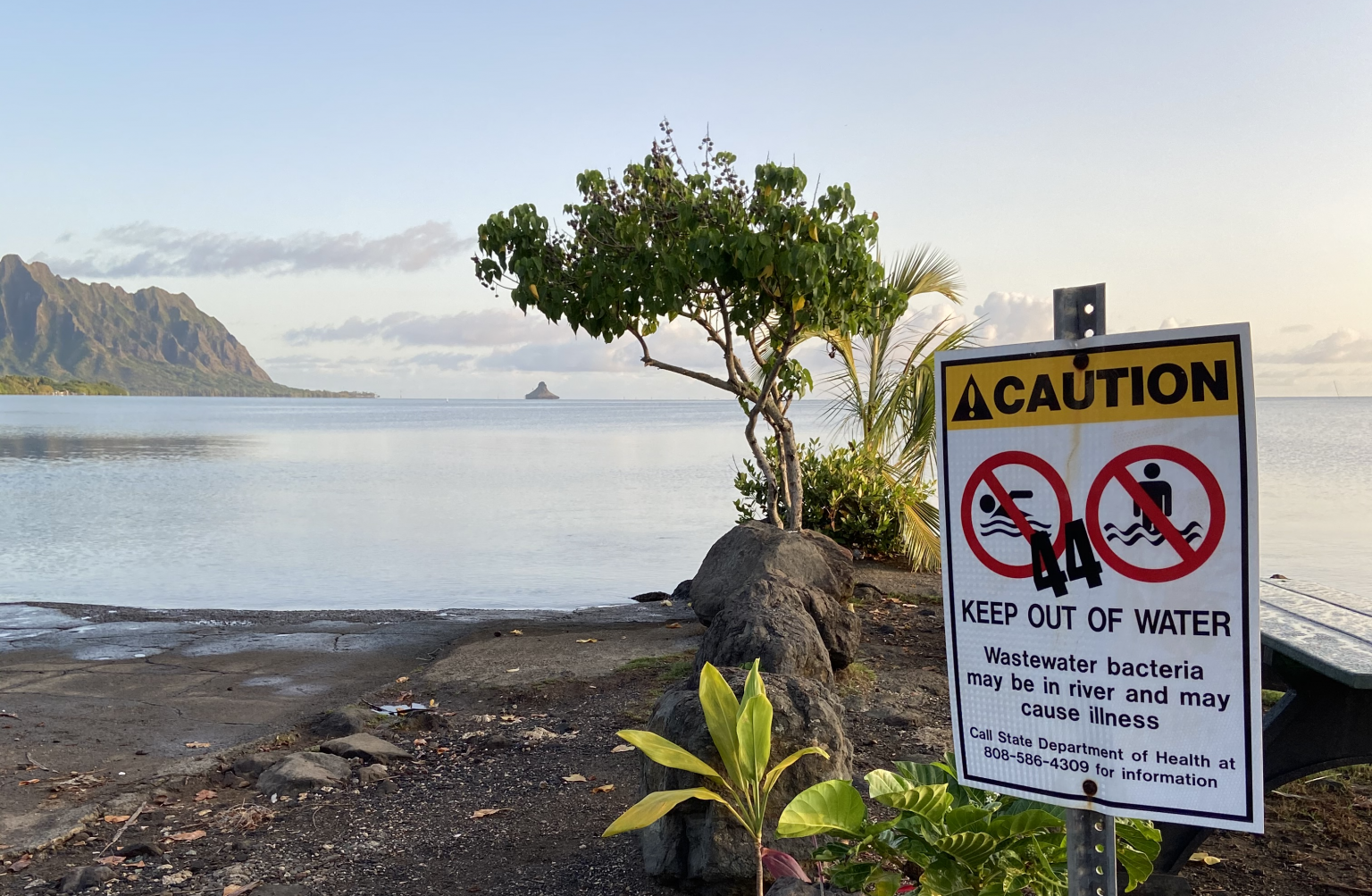
Caution signs at Kahaluʻu warn of wastewater pollution. The state has a 2050 deadline to eliminate cesspools, but many homeowners are struggling to cover conversion costs. (Courtesy: Surfrider Foundation/2022)
The measure looks to create a new low-interest revolving loan fund, run by the state’s Hawaiʻi Green Infrastructure Authority, to remove some of Hawaiʻi’s more than 80,000 cesspools, which leak an estimated 50 million gallons of raw sewage into nearshore waters every day.
The program could be replenished with county, state or federal funds. Kealoha Fox, Honolulu’s chief resilience officer, told senators last month she aims to have the city contribute to the fund. Coleman has said in testimony that creating the program could attract subsequent federal sources of funding.
The state has set a 2050 deadline to get rid of the pervasive sewage pits, but costs to do that — tens of thousands of dollars to convert just one cesspool — remain a massive challenge for most local homeowners. In many cases, the costs are too much for them to bear.
More: Hawaiʻi Homeowners Need More Options To Get Rid Of All Cesspools By 2050
The cesspool revolving loan program, Green Infrastructure Authority Executive Director Gwen Yamamoto Lau said, would offer some options. It would give some owners who don’t qualify for a bank loan a way to access a low-interest loan or, in some cases, a forgivable loan.
“We’re providing gap financing for people,” Yamamoto Lau said. “That’s what we’re doing.”
On Thursday, she recommended to senators that they use some of Hawaiʻi’s new green fee dollars to fund the program. She also suggested they start the revolving fund with $1 million.
A Second Chance
Lawmakers are weighing the proposal as communities on Oʻahu’s North Shore, which is rife with cesspools, continue to dig out from the flooding of last month’s Kona low storms.
Typically, the raw sewage from cesspools seeps into nearby groundwater before making its way into the ocean. When the state floods, former state deputy attorney general and environmental advocate Ted Bohlen said, that sewage flushes into the flood waters, too.
“You’ve got a lot of people on the North Shore right now walking around in polluted water, probably not even aware of it,” said Bohlen, who’s also a member of the state’s Cesspool Conversion Working Group. “If they have cuts they could get pretty sick because you got the raw waste coming out.”
Brown water off Haleʻiwa’s Ali’i Beach Park after the Kona low storms in March. (Craig Fujii/Civil Beat/2026)
Three Senate committees — Agriculture and Environment, Health and Human Services, and Ways and Means — all met Thursday to reconsider the bill.
Only one senator, Republican Kurt Fevella of ʻEwa Beach, voted against the measure. Three other senators, Democrats Lynn DeCoite, Michelle Kidani and Glenn Wakai, voted yes but with reservations, signaling they have misgivings with it.
The hearing occurred after a separate committee that DeCoite chairs, Economic Development and Tourism, failed on March 25 to wrangle enough members for a quorum to vote on the measure. The move kept the bill from advancing.
That same day, DeCoite separately voted no on the measure when the Agriculture and Environment Committee took it up.
On Thursday, Sen. Mike Gabbard said that after the bill failed, he asked DeCoite if she would be willing to remove her committee from its referral designation for the measure, and she agreed.
After Thursday’s hearing, where DeCoite voted with reservations, she said the cost of living is too high in Hawaiʻi for many residents to comply with the mandate to get rid of their cesspools — even with an option for low-interest or forgivable loans.
“What do I do with most of my Native Hawaiian people that live on the ocean side that cannot convert?” said DeCoite, who represents Molokaʻi and Lānaʻi, plus east and Upcountry Maui.
Bohlen said there’s no question residents will need more financial help. “I hope in the future that there will be federal money, there will be state money, there will be foundation money,” he said, “because we can’t expect homeowners to bear it all.”
Bohlen further expressed hope that new technologies requiring less excavation would eventually make the cost to convert those cesspools cheaper.
Civil Beat’s coverage of climate change and the environment is supported by The Healy Foundation, the Marisla Fund of the Hawai‘i Community Foundation and the Frost Family Foundation.Coverage of environmental issues on Hawaiʻi island is supported in part by a grant from the Dorrance Family Foundation.